How should a small UK business approach loans and funding for equipment? The short answer is that asset finance and business loans are tools to match larger costs with the income those assets will generate.
For a first time borrower, the safest route is to build a clear plan before you speak to a broker. That plan sets out what you want to buy, how long it will be useful, what repayments you can afford each month, and how borrowing will appear in your accounts and tax returns. The team at Henry and Banwell Chartered Accountants in Bristol work with owners and finance managers across the UK to build this type of plan in a structured way.
This guide explains how accountants think about different types of business borrowing, how tax and cash flow interact with loan structures, how brokers such as Onsite Finance might view your application, and a simple case study that shows the planning process in practice.
What business loans and equipment funding mean for UK small businesses
Defining core products in plain English
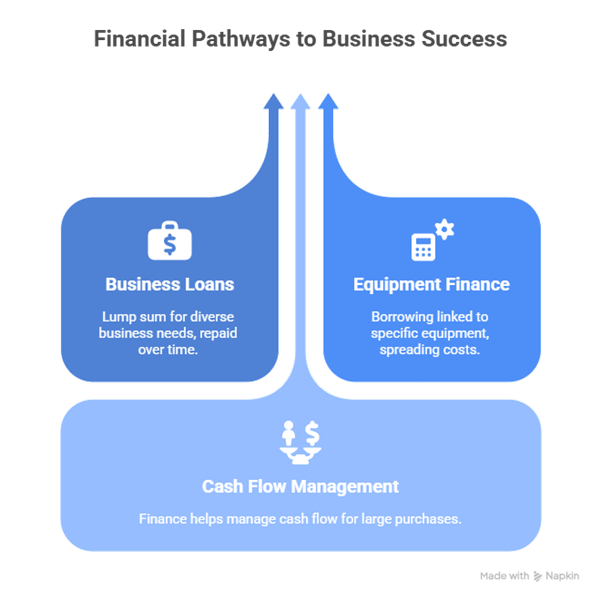
When accountants talk about funding, they usually start with two broad ideas. A business loan is a lump sum you borrow and repay over an agreed term with interest. You can use it for many different purposes, such as marketing, hiring staff, or smoothing cash flow.
Finance secured on equipment or vehicles ties borrowing to specific items the business uses. The lender takes comfort from the value of the asset as well as the strength of your business. This type of facility often comes as leasing or hire purchase. In both cases you spread the cost of equipment over its useful life instead of paying for it all at once.
Why businesses use finance instead of cash
Many small businesses could, in theory, pay for new equipment from savings. The problem is that a large one off payment can weaken day to day cash flow, especially if customers pay on longer terms or sales are seasonal.
Industry data from the Finance & Leasing Association shows that in 2024 its members provided £39.7 billion of funding to businesses and the public sector, supporting almost a third of UK investment in machinery, equipment and purchased software. That scale shows how common it is for organisations to spread the cost of investment rather than pay in one go.
Lending to smaller businesses through loans is also significant. UK Finance reports that gross lending to SMEs by the main retail banks reached nearly £4.6 billion in the first quarter of 2025, almost 14 per cent higher than a year earlier. Accountants keep an eye on these trends because they influence the range of facilities available to clients.
The accountant’s checklist before you apply for funding
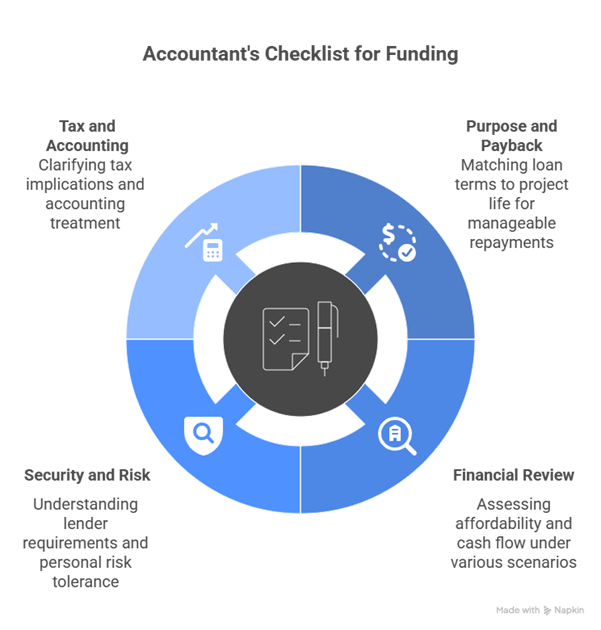
Clarifying the purpose and payback period
Before looking at products, an accountant will ask why you want to borrow and how long the benefit will last. Funding a short project with a very long term loan can cost more interest than you need to pay. At the same time, using a short term overdraft for a long term asset can create constant pressure on cash flow.
In simple terms, they try to match the term of the borrowing to the life of the asset or project. For example, if you expect a piece of equipment to be useful for five years, a four to five year repayment profile is usually more comfortable than a two year schedule.
Understanding your numbers and cash flow
Next, your accountant will look at recent accounts, management figures, and forecasts. They want to see whether the business can cover repayments not only in a normal month but also in quieter periods. This means building a cash flow forecast that shows income, costs, existing borrowing, and the new facility side by side.
They will test different scenarios. What happens if a major client pays late, or if sales dip for three months. This exercise does not have to be complex, but it gives a realistic view of how much headroom you have and what level of repayment feels comfortable.
Security, personal guarantees, and risk appetite
Most UK lenders will look for some form of security. For loans tied to equipment, the items being bought can provide this. For unsecured loans, a lender may ask directors to sign a personal guarantee instead.
Your accountant can explain what these arrangements mean in practice. They will talk through what might happen if the business struggles to meet repayments, and how much personal risk you are willing to take on. This leads to a more grounded decision about both the amount and type of borrowing.
Tax, VAT, and accounting treatment
The structure of a loan or lease affects how it appears in your accounts and how tax relief arises. For example, funding certain types of equipment may allow you to claim capital allowances. Some leases are treated as day to day costs. Others create an asset and liability on the balance sheet.
Your accountant will explain which costs hit the profit and loss account immediately and which are spread over time. They will also check how VAT is handled on purchase, repayments, and any service elements. This helps you avoid surprises around tax payments later on.
Comparing common options: loan, lease, or hire purchase
Term loans for working capital and projects
A straightforward term loan is often used for general business purposes. You receive funds up front and repay by monthly instalments over a fixed period. This works well when you are funding a mix of costs, such as marketing, recruitment, and short term projects that do not tie to specific equipment.
From an accountant’s point of view, the questions are simple. Does the loan increase capacity to generate profit. Will future income cover the repayments with a margin for safety. Is the interest rate fair once fees and charges are included.
Leasing and hire purchase for equipment heavy businesses
Leasing spreads the use of equipment and the cost over time. In an operating style lease, you may never own the kit but you have access to it for as long as you pay the rentals. This can suit technology that becomes outdated quickly.
Hire purchase usually leads to ownership at the end of the term once you have paid all instalments and any option fee. It is often used for vehicles, plant, and longer life machinery. For both structures, your accountant will look at how rentals or instalments fit with the revenue the asset will help you earn.
A practical accountant’s breakdown of business loans and asset finance
When to use asset backed facilities and when unsecured borrowing fits better
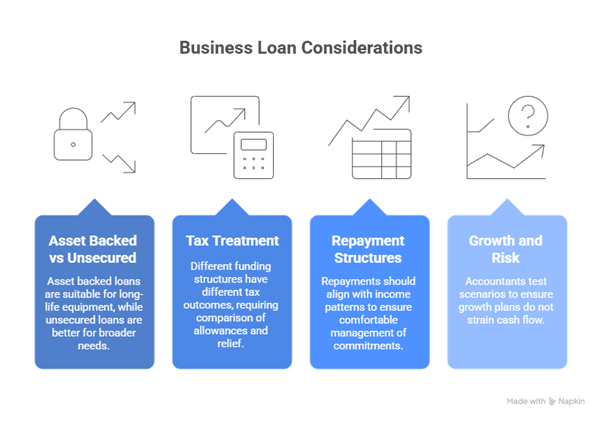
Accountants often prefer to link borrowing on longer life equipment to the asset itself. This spreads the cost over the period the item is helping you generate income, and can keep your main banking lines free for other needs. It can also give lenders greater comfort, because they have a clear view of what they are funding.
Unsecured borrowing can be more suitable when you need flexibility or when costs do not relate to specific items. Examples include moving to larger premises, adding staff ahead of winning contracts, or building a marketing campaign. Here, a term loan or revolving facility gives you room to move without tying borrowing to a single purchase.
How tax treatment differs in practice
Different funding structures can have different tax outcomes. With some equipment purchases, you may claim capital allowances while also deducting part of the interest as a finance cost. With some leases, you deduct rentals as a trading expense instead. Accounting rules can also distinguish between arrangements that sit on the balance sheet and those that do not.
An accountant will compare these outcomes across options. The right choice is not only about the lowest interest rate. It also considers when tax relief arises and how predictable the pattern of costs is from year to year. If you would like a deeper introduction to these options, Onsite Finance has an informative guide to asset finance that sets out the main types in more detail.
How repayment structures interact with cash flow timing
Repayments can be level each month, quarterly, seasonal, or include a larger amount at the end of the term. The structure needs to match the flow of income as closely as possible.
If your income is quite stable, a level monthly payment may be easiest to plan. If work is seasonal, an accountant may suggest higher repayments in strong months and lower ones in quieter periods. For a project with a clear end payment, such as a fixed fee contract, they might test whether a final lump sum repayment feels safe once that income is received.
Simple scenarios that balance growth and risk
A small design practice that wants to upgrade its studio could spread the cost of new workstations and software over three years through a facility secured on those items, while keeping a separate overdraft for day to day costs. This reduces the risk of having to cut other spending when a single bill arrives.
A consultancy that needs short term working capital to deliver a new contract might instead use an unsecured term loan with a shorter repayment profile. The accountant would map repayments against the expected fees from that contract to check that the loan is cleared from those earnings rather than general cash.
Working with an accountant and a specialist broker side by side
How an accountant prepares your application pack
A well prepared application can make conversations with lenders smoother. Accountants help by producing recent management accounts, up to date annual accounts, cash flow forecasts, and a clear written explanation of what the funds are for.
They will also check that director information, Companies House filings, and existing borrowing schedules are consistent. This reduces the number of follow up questions from lenders and gives them a clear picture of how your business operates.
How a UK broker such as On-Site Finance assesses the request
Brokers look at affordability, security, and the strength of your business story. They want to understand what you are buying, how it will support revenue, and how you will repay the borrowing on time.
Government evidence on small business access to finance notes that non bank lenders supplied around 37 per cent of new SME facilities secured on assets in 2023. That growth means there is a broad market of providers who can look beyond traditional bank lending, especially when accountants help present the numbers in a clear way.
Why joint planning reduces surprises later
When accountants and brokers speak early in the process, they can spot gaps in information and clarify any issues. This reduces the chance of last minute changes to terms or delays in releasing funds.
Joint planning also means that the repayment structure you agree with the lender is one your accountant has already tested in your cash flow model. That alignment reduces the risk of uncomfortable surprises six or twelve months into the agreement.
Case study: A professional services firm planning its first equipment purchase
Business overview and why they approached Henry & Banwell
A small UK surveying firm wanted to invest in new measurement equipment and large format printing kit. The directors had always avoided borrowing and were unsure whether to use savings or seek external funding.
They approached Henry & Banwell for help because they wanted a clear view of how different borrowing options would affect cash flow and tax over the next few years, rather than focusing only on the interest rate.
What Henry & Banwell did
The accountant reviewed the firm’s recent accounts and prepared a twelve month cash flow forecast that included the proposed equipment purchase. They modelled three options. Paying from savings. Using a three year term loan. Using facilities secured on the equipment with repayments over five years.
For each option, they showed how bank balances, tax payments, and profit would look over the forecast period. They also considered the directors’ views on personal guarantees and how much risk they were comfortable taking on.
The results and what changed for the client
The firm chose to fund the equipment through facilities secured on the new kit over five years, while keeping some savings back as a buffer. The forecast showed that this structure kept monthly repayments at a level that could be covered by existing work and expected new projects.
With a clear plan in place, the directors felt more confident about signing the agreement. They also agreed to update their cash flow forecast every quarter so that any future investment decisions could follow the same structured approach.
Wrapping Up – Practical planning tips before you sign a finance agreement
Before you agree to any business loans or other funding, it helps to write down a short plan that covers a few key questions. What are you buying and how long will it be useful. How will the purchase increase capacity or improve service. How will repayments fit with your income pattern and existing borrowing. How might tax, VAT, and accounting treatment differ between options.
If you can answer these questions in plain English, you are already close to the way accountants think about funding. Used in this planned way, asset finance becomes part of a wider funding strategy, not a quick fix. Working through these steps with your accountant helps ensure each funding decision supports the long term health of the business.
FAQs
What is funding secured on assets for a small UK business in simple terms
This is borrowing that is linked to specific items, such as vehicles, machinery, or technology. The lender takes comfort from the value and use of those items as well as the general strength of the business. Repayments are usually spread over the period you expect to use the equipment.
How do I know if I should use a business loan or finance specific assets instead
If your costs are tied to particular items with a clear useful life, facilities secured on those assets can be a good fit. If you need funding for a range of general costs, such as payroll, marketing, or project delivery, a broader business loan may be more suitable. Accountants can model both options so you can see how each one affects cash flow and tax.
Will a lender always ask for a personal guarantee on small business borrowing
Not always, but it is common for unsecured facilities. When a loan or lease is secured on equipment, that asset sometimes provides enough comfort for the lender. Your accountant can help you read the terms, explain what the guarantee would mean in practice, and discuss whether the level of personal risk feels acceptable.
How does funding secured on assets appear in my accounts and tax return
Some arrangements create an asset and a liability on your balance sheet, with interest and depreciation recorded in your accounts. Others may be treated more like a service where you deduct rentals as an ongoing cost. The exact treatment depends on the terms of the agreement and current accounting rules, which your accountant can explain in the context of your business.
Can my accountant speak to a broker such as On-Site Finance on my behalf
Yes, many brokers welcome contact from accountants because it helps them understand the business more clearly. Your accountant can prepare figures, answer technical questions about the accounts, and help both sides agree a structure that fits the business. This can save time and reduce the chance of misunderstandings during the application process.